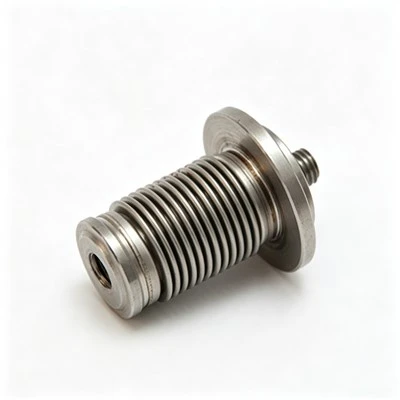
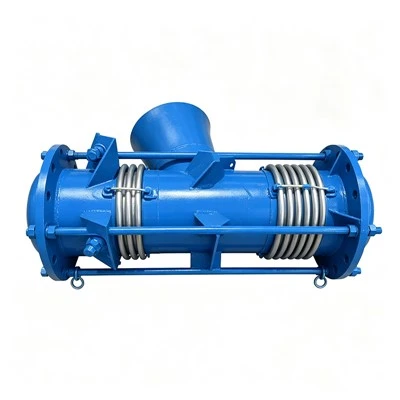
Axial Corrugated Expansion Joint Introduction: This type of expansion joint consists of two corrugated sections, a short intermediate pipe, and a long tie rod. It only absorbs axial displacement; its long tie rod is not a bearing component. Applications: Chemical, mining and metallurgy, aerospace, machinery, shipbuilding, instrumentation, energy, power, transportation, construction, and other engineering fields. Function: Compensates for deformation caused by thermal expansion and contraction of engineering pipeline systems, and compensates for displacement caused by asynchronous settlement or crustal changes in buildings, equipment, oil tanks, etc.
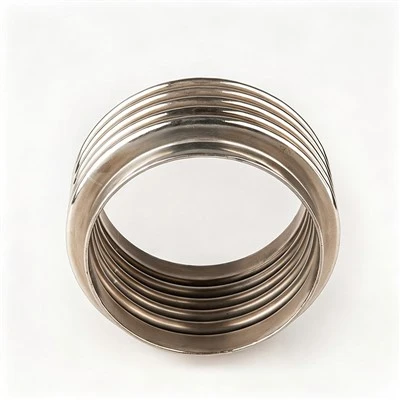
Circular Corrugated Expansion Joint Introduction: This type of expansion joint consists of a corrugated pipe and two end pipes. It absorbs axial displacement (and a small amount of lateral and angular displacement) of the pipeline through the flexible deformation of the corrugated pipe, and welds end nozzles or pipe nozzles, or welds flanges and then connects to the pipe flanges. The small tie rod on the expansion joint mainly serves as rigid support during transportation or as pre-deformation adjustment for products and is not a load-bearing component. This type of expansion joint has a simple structure and low price, so it should be given priority in any possible location on the pipeline. Due to the corrosive flow of the medium, PTFE can be added. Applications: Chemical, mining and metallurgy, aviation, machinery, shipbuilding and instrumentation, energy, power, transportation, construction and other engineering fields. Function: Compensates for deformation caused by thermal expansion and contraction of engineering pipeline systems, and compensates for displacement caused by asynchronous settlement or crustal changes in buildings, equipment, oil tanks, etc.
Large Tie-Rod Lateral Corrugated Expansion Joint: This expansion joint consists of two corrugated pipes, a long intermediate connecting pipe, and a large tie rod. It can absorb lateral displacement of the pipeline system in any plane. The spherical nut on the large rod rotates around the spherical washer during displacement, and the large rod also has the ability to withstand internal pressure thrust. Applications: Chemical, mining and metallurgy, aviation, machinery, shipbuilding and instrumentation, energy, power, transportation, construction and other engineering fields. Function: Compensates for deformation caused by thermal expansion and contraction of engineering pipeline systems, and compensates for displacement caused by asynchronous settlement or crustal changes in buildings, equipment, oil tanks, etc.
Straight Pipe Bypass Pressure Balanced Expansion Joint Introduction: It has the ability to absorb internal pressure thrust and features good directionality and low product stiffness. Applications: Chemical, mining and metallurgy, aerospace machinery, shipbuilding instruments, energy, power, transportation, construction, and other engineering fields. Function: Compensates for deformation caused by thermal expansion and contraction of engineering pipeline systems, and compensates for displacement caused by asynchronous subsidence of buildings, equipment, oil tanks, or crustal changes.
Unrestrained Expansion Joint Introduction: This type of expansion joint has strong support and directional performance. It features highly reliable columnar stability, overcoming the "torsion" and instability issues commonly found in previous axial expansion joints. It offers advantages such as a higher bellows count, multi-layer application, and large compensation capacity. Applications: Chemical, mining and metallurgy, aerospace, machinery, shipbuilding instruments, energy, power, transportation, construction, and other engineering fields. Function: Compensates for deformation caused by thermal expansion and contraction of engineering pipeline systems, and compensates for displacement caused by asynchronous subsidence of buildings, equipment, oil tanks, or crustal changes.
Composite Tie-Rod Lateral Expansion Joint Introduction: The expansion joint consists of a nozzle, two bellows, and a large tie rod, absorbing only lateral displacement in any plane of the pipeline system. The spherical nut on the tie rod rotates around a spherical washer during displacement, and the tie rod also has the ability to withstand internal pressure thrust. Applications: Chemical, mining and metallurgy, aviation, machinery, shipbuilding and instrumentation, energy, power, transportation, construction and other engineering fields. Function: Compensates for deformation caused by thermal expansion and contraction of engineering pipeline systems, and compensates for displacement caused by asynchronous settlement of buildings, equipment, oil tanks or crustal changes.
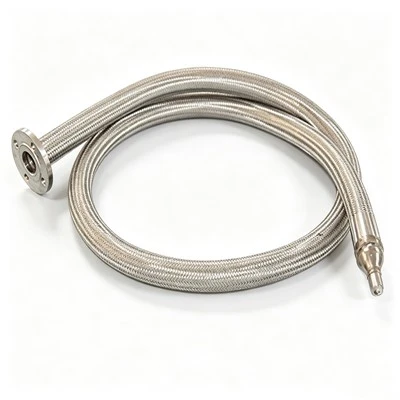
Damping Expansion Joint Introduction: It consists of a bellows, two end flanges, and other components. It absorbs small amounts of three-dimensional displacement of the pipeline through corrugated flexible deformation. It is mainly used for vibration reduction, noise reduction, and extending the life of equipment and its pipeline systems. It is used in power equipment, such as the inlet and outlet of medium and low pressure pumps. Applications: Chemical, mining and metallurgy, aviation, machinery, shipbuilding and instrumentation, energy, power, transportation, construction and other engineering fields. Function: Compensates for deformation caused by thermal expansion and contraction of engineering pipeline systems, and compensates for displacement caused by asynchronous settlement of buildings, equipment, oil tanks or crustal changes.