Installation Stress in Pipelines
In complex piping systems, spatial constraints often create various installation difficulties: pre-formed pipes cannot be installed; pipes that are bent and straightened are inevitably fitted with localized cold straightening. Depending on the pipe diameter and specific site conditions, the cold straightening amount ranges from a few millimeters to tens of millimeters, and sometimes even hundreds of millimeters. Practice has shown that the greater this amount, the higher the internal stress. These residual installation stresses in the piping system are undoubtedly a significant hidden danger.
A section of bearing lubricating oil conduit in a certain type of engine repeatedly fractured during actual operation due to excessive installation stress.
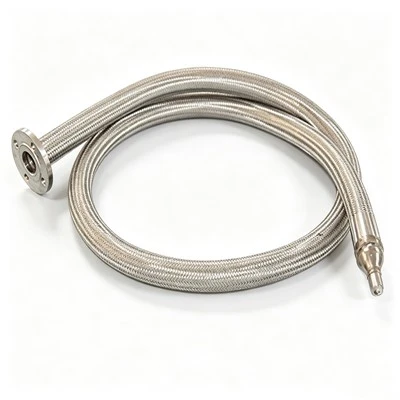
Because it can be bent freely and generates minimal internal stress under rated bending radius conditions, it greatly facilitates installation and plays a certain role in ensuring the safe operation of the piping system. This is the main reason why some piping systems must use metal flexible hoses.
Compensation for Pipeline Position
Due to the need for loading and unloading molds, the movable cylinder on the vulcanizing machine will move upward and downward. After repeated reciprocating motion, copper serpentine hoses will experience fatigue fracture. Although they can be repaired and reused, the downtime for repairs results in lost time. While rubber hoses possess excellent flexibility and strong fatigue resistance, they are weak in pressure resistance, temperature resistance, and aging resistance, and generally cannot be used for more than a few months. The superior comprehensive performance of metal flexible hoses is fully demonstrated here. In general industrial fields, in addition to pressure and temperature, there are often harsh conditions such as fatigue, corrosion, vibration, compression, and impact. Under such circumstances, flexible hoses are most suitable for compensating for pipeline displacement.
Vibration Absorption
In a large building, the air conditioning in the lobby is supplied by a 6FWB unit fixed in the basement. The vibration of the unit is transmitted to the ground floor lobby through the connecting pipes, resulting in a noise level of 45dB. In such an environment, people often experience discomfort. After the design improvement, flexible metal hoses were connected in series with the connecting pipes. This not only absorbed some of the noise generated by the unit's vibration, but also significantly reduced the noise generated by fluid pulsation in the piping system. As a result, the noise level in the lobby was only 33 dB, greatly improving the environment.
By absorbing vibration, flexible metal hoses not only improve the system's resistance to fatigue failure but also reduce noise. This is why some piping systems use flexible metal hoses.