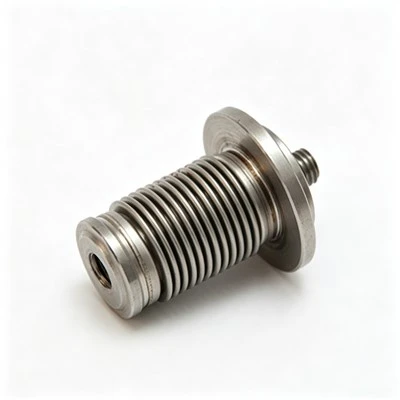
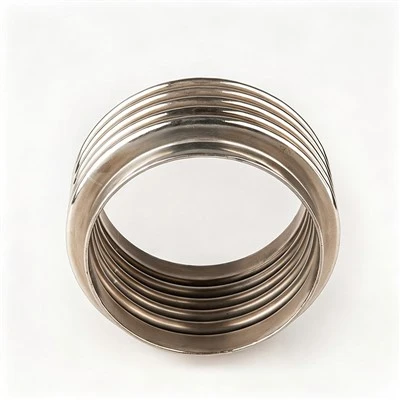
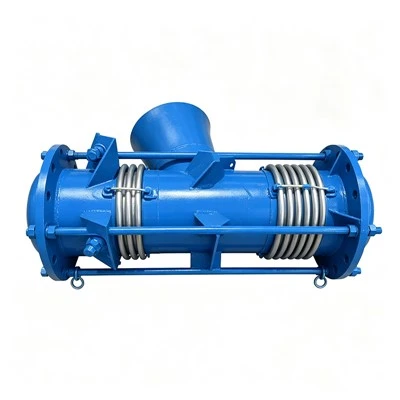
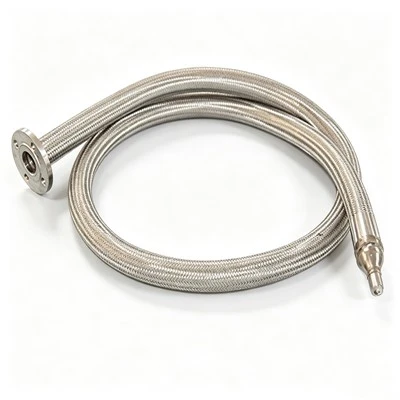
A bellows is a tubular elastic sensing element made of foldable corrugated sheets connected along the folding and stretching direction. Bellows are widely used in instrumentation, primarily as measuring elements in pressure gauges, converting pressure into displacement or force.
Bellows have thin walls, high sensitivity, and a measuring range from tens of Pascals to tens of megapascals. Its open end is fixed, while the sealed end is in a free state, with auxiliary helical springs or leaf springs used to increase elasticity. During operation, under internal pressure, it stretches along the length of the tube, causing the moving end to produce a displacement proportional to the pressure.
The moving end drives a pointer to directly indicate the pressure magnitude. Bellows are often combined with displacement sensors to form pressure sensors that output electrical signals; they are also sometimes used as isolation elements. Because the stretching of a bellows requires a large volume change, its response speed is slower than that of a Bourdon tube. Bellows are suitable for measuring low pressure.