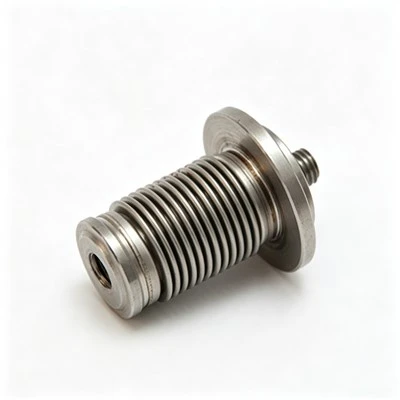
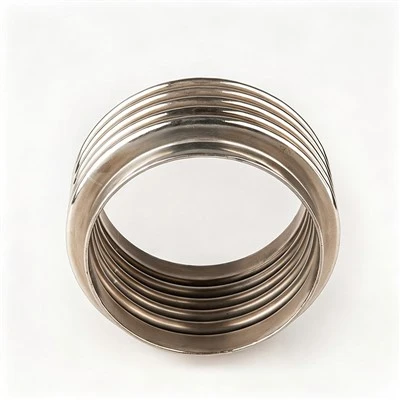
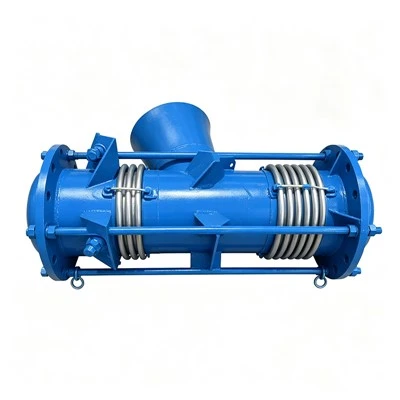
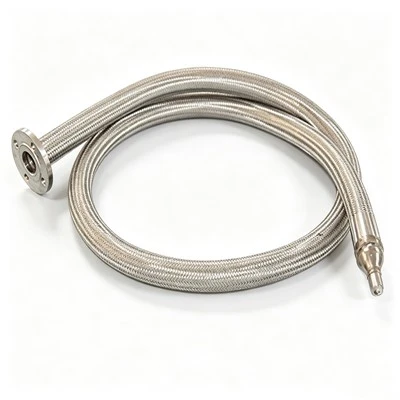
The theoretical basis for the design of metal bellows lies in plate and shell theory, mechanics of materials, and computational mathematics. There are many parameters involved in bellows design, and the focus of the design calculations varies depending on the bellows' application in the system. For example, when bellows are used in force balancing components, their effective area must remain constant or change very little within the operating range; when used in measuring components, their elastic properties must be linear; when used as vacuum seals in vacuum switching tubes, the bellows must meet requirements for vacuum sealing, axial displacement, and fatigue life; when used as seals in valves, the bellows must possess certain pressure resistance, corrosion resistance, temperature resistance, operating displacement, and fatigue life. Based on the structural characteristics of the bellows, it can be considered as composed of a circular shell, a flat conical shell, or a circular plate. Designing and calculating a bellows is essentially designing and calculating a circular shell, a flat conical shell, or a circular plate.
The parameters calculated include stiffness, stress, effective area, instability, allowable displacement, pressure resistance, and service life.
Pressure Resistance: Pressure resistance is a crucial parameter for bellows performance. The maximum static pressure that a bellows can withstand at room temperature without plastic deformation is its maximum pressure resistance. Under normal circumstances, bellows operate under a certain pressure (internal or external), so they must withstand this pressure without plastic deformation throughout their operation.
The pressure resistance of a bellows actually falls under the category of its strength. The key to calculation is stress analysis, which involves analyzing the stress on the bellows wall. As long as the stress at the point of maximum stress on the bellows wall does not exceed the yield strength of the material, the pressure on the bellows will not reach its pressure resistance.
Under the same operating conditions, the same bellows is more stable under external pressure than under internal pressure. Therefore, the maximum pressure resistance under external pressure is higher than that under internal pressure.
When both ends of a bellows are fixed, if a sufficiently large pressure is introduced into its internal cavity, the bellows crests may burst and fail. The pressure value inside the bellows when bursting begins is called the burst pressure. Burst pressure is a parameter characterizing the maximum pressure resistance of a bellows. Throughout its operation, the working pressure of the bellows is far lower than its burst pressure; otherwise, the bellows will rupture and be damaged.
When the corrugated length is less than or equal to the outer diameter, the calculated result is very close to the actual burst pressure; for slender bellows, the actual burst pressure is much lower. The burst pressure is approximately 3 to 10 times the allowable working pressure.
Stability: When both ends of the bellows are restricted, if the pressure inside the bellows increases to a certain critical value, the bellows will become unstable.
Allowable Displacement: For a bellows operating under compression, its maximum compressive displacement is the maximum displacement that the bellows can produce when compressed under pressure until the corrugations come into contact with each other. This is also called the maximum allowable structural displacement, and it is equal to the difference between the free length and the maximum compressed length of the bellows.
The maximum displacement that the bellows can achieve without plastic deformation is called the allowable displacement of the bellows.
During actual operation, bellows will produce residual deformation, also known as permanent deformation or plastic deformation. Residual deformation refers to the phenomenon where a bellows deforms under force or pressure, and does not return to its original state after the force or pressure is removed. It is usually expressed as the amount by which the bellows does not return to its original position, also known as zero-position offset.
Regarding the relationship between bellows displacement and zero-position offset, whether it is tensile or compressive displacement, in the initial stage of the bellows displacement, its residual deformation is very small, generally less than the allowable zero-position offset value specified in the bellows standard. However, when the tensile (or compressive) displacement gradually increases to exceed a certain value, it will cause a sudden increase in the zero-position offset value. This indicates that the bellows has produced relatively large residual deformation. After this point, if the displacement is increased even slightly, the residual deformation will increase significantly. Therefore, the bellows should generally not exceed this displacement amount; otherwise, its accuracy, stability, reliability, and service life will be severely reduced.
The allowable compressive displacement of a bellows under compression is greater than its allowable tensile displacement under tension. Therefore, bellows should be designed to operate under compression as much as possible. Experiments have shown that, under normal circumstances, for bellows of the same material and specifications, the allowable compressive displacement is 1.5 times the allowable tensile displacement.
The allowable displacement is related to the bellows' geometric dimensions and material properties. Generally, the allowable displacement is directly proportional to the material's yield strength and the square of the outer diameter, and inversely proportional to the material's elastic modulus and the bellows' wall thickness. The relative corrugation depth and thickness also have some influence.
Lifespan: The lifespan of a bellows is the shortest possible operating period or number of cycles required to ensure normal operation under working conditions. Elastic sealing systems composed of bellows often operate under varying loads and large displacements with a high number of cycles; therefore, determining the bellows' lifespan is crucial. Because different functions of bellows require different lifespans...
(1) When bellows is used to compensate for positional deviations caused by installation in a piping system, its lifespan requirement is only a few cycles.
(2) When bellows is used in thermostats with high switching frequencies, its lifespan must reach 10,000 cycles to meet usage requirements.
(3) When bellows is used as a vacuum seal in vacuum switches, its lifespan must reach 30,000 cycles to ensure normal operation.
As can be seen from the above three usage examples, the required lifespan of bellows varies greatly due to different usage conditions. The lifespan of a bellows is related to the fatigue characteristics of the selected material, as well as the magnitude of residual stress in the formed bellows, stress concentration, and surface quality. Furthermore, the lifespan is related to the working conditions of the bellows, such as displacement, pressure, temperature, working medium, vibration conditions, frequency range, and impact conditions.
During operation, the lifespan of a bellows mainly depends on the maximum stress generated during operation. To reduce stress, this is generally achieved by reducing the working displacement of the bellows and lowering the working pressure. In general design, the working displacement of a bellows should be less than half of its allowable displacement, and its working pressure should be less than half of its pressure resistance.
Tests on manufactured bellows have shown that if the bellows operate according to these specifications, its service life can generally reach approximately 50,000 cycles.
Depending on the nature of the working pressure, the allowable displacement of the bellows also varies. Generally, when the bellows only bears axial loads (tension or compression), its allowable displacement can be selected between 10% and 40% of the effective length of the bellows; however, when the bellows bears lateral concentrated forces, torsional moments, or combined forces, the allowable displacement should be appropriately reduced.
Using multi-layered bellows can reduce stiffness and stress caused by deformation, thus significantly improving the bellows' lifespan.
When bellows operate under the same conditions but with different working pressure characteristics (constant or alternating load), their service life will differ. Obviously, the lifespan of a bellows operating under alternating loads is shorter than that under constant loads.